
Dependence & Withdrawal
Opioid-like dependence and severe withdrawal requiring treatment with medications like buprenorphine and methadone.
Learn More →This library compiles peer‑reviewed evidence, FDA reports, and CDC case studies documenting the dangers of unregulated whole‑leaf kratom – dependence, withdrawal, liver injury, cardiac arrest, and deaths.
We advocate for evidence‑based policy that protects public health, informs lawmakers, and prevents harm from unregulated kratom – including natural whole leaf products, not just high‑potency extracts.
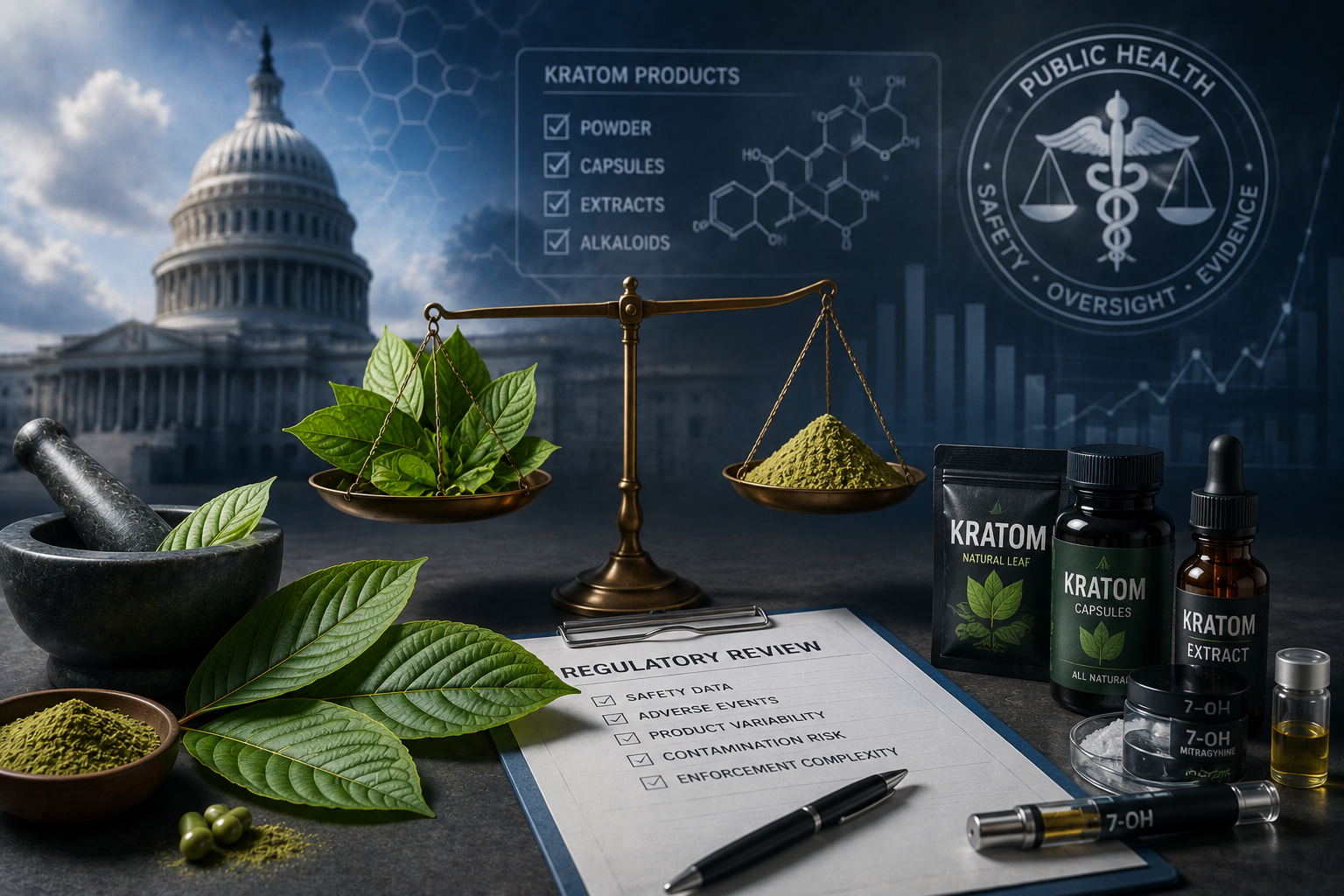
Even before high‑potency 7‑OH extracts emerged, whole‑leaf kratom was associated with severe outcomes, contamination, and healthcare burden. Understanding the full market matters for effective regulation.
LEARN MORE →
Despite decades of documented harms, whole‑leaf kratom remains unregulated. Learn why federal action has stalled – and what can still be done.
Learn More →
An evidence-based introduction to international kratom shipping records for lawmakers. Bills of lading, HTS codes, FDA Import Alert 54-15, and public records.
Explore the Series →


Scientific evidence shows significant public health risks from whole‑leaf kratom and its alkaloids.
Opioid-like dependence and severe withdrawal requiring treatment with medications like buprenorphine and methadone.
Learn More →
Reports of Brugada syndrome, QT prolongation, arrhythmias, cardiac arrest, and sudden death in healthy individuals.
Learn More →
Cases of cholestatic injury, liver failure, and transplant linked to kratom use. Recovery often occurs after cessation (NIH LiverTox).
Learn More →
Evidence of neonatal withdrawal, limited safety data, and potential harm to developing infants.
Learn More →
Increasing use among adolescents and college students fueled by aggressive marketing and easy access.
Learn More →
Heavy metals, microbes, pesticides, adulterants, and variable potency found in many products (FDA lab data).
Learn More →
Outdated laws and lack of enforcement leave families vulnerable. We provide the data, documents, and expert analysis needed to protect communities. (State Laws Summary)
Resources for Lawmakers →
Three University of Florida researchers recommended a 40 mg mitragynine serving limit while holding inventor status on a patent application for technology designed to increase mitragynine absorption. Christopher McCurdy, Abhisheak Sharma, and Erin Berthold appear on both the October 2026 regulatory policy paper and the university's patent application, which includes formulations containing up to 40 mg of mitragynine. Yet the published conflict-of-interest statement makes no mention of the patent. Why does that matter? A milligram ceiling limits the amount of drug in a serving, not necessarily how much reaches the bloodstream. Enhanced-absorption technology could offer a competitive advantage if permitted under the proposed rules. Even American Kratom Association lobbyist Mac Haddow questioned the missing disclosure. This investigation examines the original patent, the proposed regulatory limits, the potential commercial implications, and the questions the researchers and their journal have yet to answer.

The kratom industry urges lawmakers to distinguish natural kratom from chemically modified 7-OH products. But a manufacturer's own FDA submission exposes a critical connection. In December 2025, FDA explicitly acknowledged that Shaman Botanicals' 7-OH was manufactured from kratom and demanded detailed records identifying its raw materials and manufacturing process. The company's subsequent disclosures were heavily redacted. This investigation examines the original federal filing, the botanical supply chain behind concentrated 7-OH products, and the manufacturing relationship too often omitted from industry lobbying arguments. Read the documents lawmakers should be asking about.

A Certificate of Analysis is supposed to assure consumers that a product has been tested. But what happens when the certificate is forged, the laboratory manipulates its results, or the product bears little resemblance to what was tested? From falsified THC potency reports and concealed contaminants to troubling discrepancies in kratom labeling, this investigation examines nine documented cases and additional scientific findings. Explore regulatory enforcement records, laboratory investigations, and original sources exposing why a COA is not, by itself, proof of product safety.

A Louisiana wrongful-death lawsuit has produced an extraordinary collection of evidence involving botanical kratom, including corporate records, product warnings, autopsy findings, sworn testimony, and competing scientific opinions. Explore 280 original PACER PDFs spanning 4,819 pages, with ten detailed investigations and a full-text search engine that takes readers directly to the evidence. The allegations are contested, but the court records are available for anyone to examine.
Kratom is promoted for chronic pain, anxiety, opioid withdrawal, and numerous other medical conditions. But which licensed physicians publicly recommend or prescribe it as a treatment? This registry is reserved for documented physician endorsements supported by verifiable evidence. The first entry awaits a name.

A U.S. patent documents researchers extracting four alkaloids from commercially purchased kratom powder, developing new chemical derivatives, and demonstrating opioid-receptor activity. The research raises a question for lawmakers: What happens when the natural leaf becomes the starting material for the next generation of opioid compounds?

Congress proposes targeting potent kratom-derived compounds while leaving botanical kratom outside the bill's prohibitions. But seizures, comas, respiratory depression and deaths were documented long before 2024. We examine the bill's loopholes, the historical evidence and the American Kratom Association's support.
A 2026 placebo-controlled human study found dose-related psychoactive effects and abuse-related adverse events following dried kratom leaf consumption. We examine the findings, concerning effects, study limitations, and the involvement of American Kratom Association consultant Jack Henningfield.

The October 9 announcement introduces new concentration and alkaloid-ratio thresholds for 7-OH and mitragynine pseudoindoxyl. But the revised approach leaves botanical kratom and its mitragynine supply outside these proposed controls. The finished molecules face scheduling while their upstream source remains available.
A U.S. patent shows mitragynine extracted from kratom leaf can serve as the scaffold for dozens of chemical modifications, including compounds with altered opioid-receptor activity. States can name analogs in legislation, but identifying an unknown derivative in a retail product requires actually knowing what to test for.

PubMed case reports, FDA adverse-event data and Poison Center surveillance show different toxicity profiles. Kratom has published reports involving seizures, liver injury, rhabdomyolysis and major cardiac events; concentrated 7-OH is producing serious opioid-like and cardiac toxicity; and the human evidence on mitragynine pseudoindoxyl is only beginning to emerge.
7-OH and pseudoindoxyl may look nothing like kratom leaf. But product testing, patents, UN drug monitoring and commercial manufacturing evidence trace the chemistry upstream: raw kratom supplies mitragynine, the starting material manufacturers can chemically transform into increasingly potent products.

FDA records show 1,177 kratom refusals—yet since 2020, 180 kratom entry lines categorized as Human Food were allowed to proceed or released. Twenty-four were detained first, then released. We compared FDA’s own data with U.S. bills of lading to examine what is getting through.

Kratom itself cannot be sold, sampled, distributed or openly possessed at the 2026 NACS Show. Its manufacturers, however, can exhibit and market to the convenience-store industry. We identified the kratom companies headed to Las Vegas—and examined the pipeline from manufacturer to gas-station shelf.

Arizona alleges the founder tested Feel Free on himself at “abusive levels”—about six bottles a day until he “felt toxic”—before the product was mass-marketed as wellness, energy and an alcohol alternative. Now the State is putting what the company allegedly knew, how it marketed the product, and how it encouraged repeat purchases before a court.

Police officers, firefighters, nurses, truck drivers and equipment operators described kratom use while working in safety-sensitive roles. Meanwhile, court-submitted science discusses seizures, psychosis, sedation, hallucinations and impaired cognition—and standard workplace testing may never look for it.

Under oath and in its own filings: mitragynine as a partial mu-opioid agonist, admitted addiction potential, extract concentration risks, finished-product uncertainty, and 1,600+ retail outlets. Read the record—not the talking points.

Under oath and in its own filings: MP in natural leaf, acknowledged kratom risks, disputed safety claims, clinical-study limits, and product-quality evidence. Read the record—not the talking points.


